

Type
Checkpoint
Publish Time
2026-02-27
Base Model
Nano Banana
Model Parameters
clip_skip:1
Training Parameters
Epochs:1
Steps:0

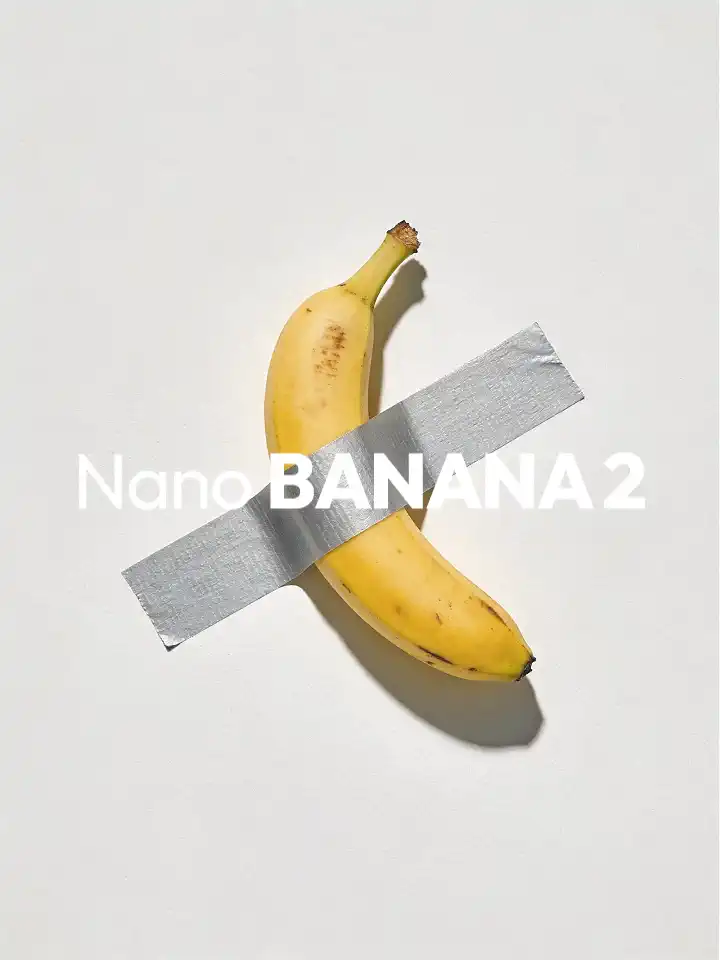
Nano Banana 2 is Google's newest image generation + image editing model, officially named Gemini 3.1 Flash Image. It’s positioned as the "fast" upgrade path from Nano Banana Pro: similar high-fidelity output, but with much faster turnaround.
On SeaArt AI, you can think of Nano Banana 2 as a production-friendly visual engine: It's designed to help creators iterate quickly while still keeping strong prompt understanding and clean image quality.
1) Text-to-Image that "gets" complex prompts
Nano Banana 2 emphasizes deep prompt understanding and stronger reasoning for image tasks, which helps when prompts contain multiple constraints (subject + environment + materials + lighting + composition + story beats).
Good for
l Multi-subject scenes with clear relationships (who is doing what, where).
l Design-like requests (layout, product shot intent, clean compositions).
l "Explainable" visuals where details must match the description.
2) Fast, precise image editing (inpainting / outpainting / style changes)
Beyond generating from scratch, Nano Banana 2 supports advanced editing workflows—think targeted fixes, extending the canvas, or transforming the look—while keeping speed as a core advantage.
Use cases
l Repair hands/faces, remove objects, replace background elements.
l Expand a portrait into a full poster frame (outpainting).
l Restyle a scene while preserving structure (style transfer).
3) Output control that fits real deliverables
Nano Banana 2 supports control over aspect ratio and resolution, with upscaling from 512px up to 4K—useful when you're creating assets intended for publishing.
Pro-level fidelity + Flash-speed iteration
Its headline positioning is a blend of high-quality results ("Pro-level intelligence and fidelity") with "lightning-fast speed," making it great for rapid creative loops.
Strong world knowledge + contextual accuracy
It's leveraging web search signals (real-time info + images) to produce outputs that are more contextually accurate—helpful for prompts that depend on current or specific real-world details.
Better price-performance for scale
Compared with earlier versions, it's positioned as more cost-effective.
1. Write constraints as a checklist
l Subject (who/what)
l Scene (where)
l Composition (wide/close-up, angle, focal length feel)
l Lighting (softbox, golden hour, neon rim)
l Materials (metal, glass, fabric)
l Output (aspect ratio, resolution, "clean background")
2. For editing, describe the change—not the whole image
l "Replace the background with …"
l "Remove the object in the left hand…"
l "Extend canvas upward to show …"
This pairs naturally with inpainting/outpainting-style workflows.
3. When you need accuracy, add "what must stay the same"
l "Keep the face identity, keep the pose, keep the color palette—only change the outfit."